
A Dental Bridge Can Fill the Gap in Your Smile
The human mouth is a fascinating but delicate part of human anatomy. Even if one tooth goes missing, you can face some significant oral health problems. Plus, no one wants to be the guy with the empty space in their grin. We want you to enjoy all the benefits of a healthy, attractive smile. One way in which we help our patients achieve this is through dental bridges in Abington.
What Is a Dental Bridge?
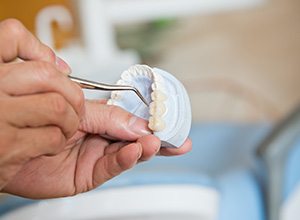 There are a few different types of dental bridges, but in all cases, the primary purpose is to “bridge” a gap in your smile. These prostheses work well for replacing one or more teeth.
The most common type of bridge is the traditional sort, which has two crowns that fit over the abutment teeth (the teeth that are next to the gap in your mouth). A pontic, otherwise called an artificial tooth, is suspended between the two crowns. This type of bridge can be very attractive and long-lasting.
You may also want to ask your dentist in Abington about an implant-supported bridge, in which the pontic(s) are supported by small titanium posts that get surgically placed into your jaw, rather than by abutment teeth. This type of bridge tends to be the strongest and longest-lasting.
Your dentist will talk to you about your unique circumstances and recommend a restorative treatment that is the a good fit for you.
What Advantages Do Dental Bridges Offer?
 Dental bridges come with significant advantages for both your appearance and your oral health, including:
- Because bridges are usually made of porcelain, they tend to look very natural in the mouth. Onlookers won’t have to know that you’ve had any work done.
- A traditional bridge lasts an average of 10 years. If you care for it well and it doesn’t become the victim of any accidents, it could endure for even longer before it needs to be replaced.
- Whenever you are missing teeth, your remaining pearly whites are in danger of drifting out of place. A bridge may prevent this unfortunate situation.
- Bridges tend to be quite sturdy, allowing you to enjoy all of your favorite snacks and meals with minimal worry.
What Is the Process Like for Getting a Dental Bridge?
 The exact process for getting a dental bridge depends on the type of bridge that’s best for you. If you opt for a traditional bridge, the installation will take place over two or more visits to your dentist. During the first visit, the doctor will prepare your abutment teeth. We’ll have to remove a bit of enamel from them so there is room for the crowns. Then, we’ll take some impressions of the area, and that information will go to a laboratory, which will create your custom restoration.
On your second visit, we’ll install your permanent bridge. We might recommend that you come back later for a few checkups so we can be sure that it works well with your bite and that all is well with your restored smile.
If you’d like to learn more about dental bridges or schedule a consultation, please get in touch with us.
Dental Bridges FAQs
Can you take a dental bridge out?
No, you cannot remove a dental bridge on your own. These prosthetics are firmly attached to either the abutment teeth or the implants that support them; they are designed to be removable only with the help of a dental professional.
You may have heard some people talk about “removable bridges,” but that term is something of a misnomer. Usually, it refers to a partial denture, which can look similar to a bridge. However, instead of being bonded in the mouth, it stays secure via small clasps. It is easy to remove without professional assistance.
Is getting a dental bridge painful?
In order to prepare your abutment teeth to support a dental bridge, our team will need to remove some of their enamel. We numb your mouth for this process, so you should feel little to no discomfort. You should not experience pain, though you may notice some pressure as we work.
When we place the bridge, you might experience some increased sensitivity. This may last for just a few days as your mouth heals and adapts to the restoration.
If you are getting an implant bridge, some soreness is to be expected after your placement surgery. Our team will provide information on how you can minimize discomfort and support your body’s recovery process.
How long should a dental bridge last?
Dental bridges in Abington may last anywhere from 5 – 15 years. Their lifespan depends on how they are cared for, the materials used to make them, and other factors.
As your dentist in Abington, our team will provide tips to help you maintain your restoration and extend its longevity. For example, you will need to keep up with a thorough oral hygiene routine and make wise dietary choices.
How many teeth can a dental bridge replace?
Dental bridges are versatile. Most often, they are used to replace 1 – 3 missing teeth in a row. If they get longer than that, they may not have the support needed to provide strong chewing power.
If you are getting implants, you might get something called a “full bridge,” which is essentially a denture that replaces either all the upper or lower teeth. Since it has multiple implants supporting it, it can be impressively strong.
Can dental bridges be whitened?
No, dental bridges do not respond to teeth whitening methods like natural dental enamel. That is because the materials used to make bridges are nonporous, so they cannot absorb bleaching agents.
We might be able to remove slight surface stains from your bridge by polishing it. However, if it is extremely discolored or badly scratched, you may have to get it replaced in order to optimize its aesthetic appeal.